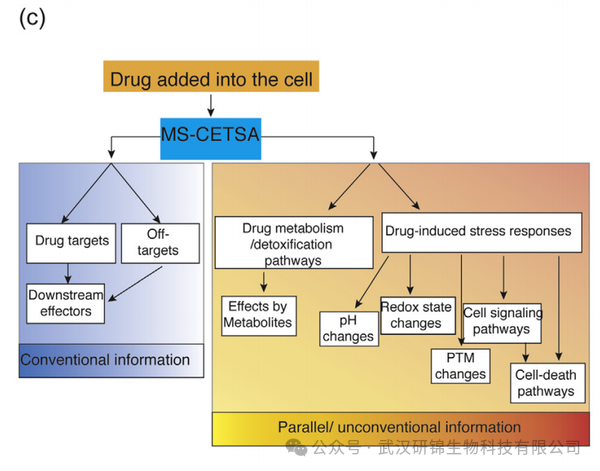
Wuhan YanGeneBio Wuhan YanGeneBio is an innovative biotechnology service company dedicated to drug target discovery and drug mechanism validation. We provide solutions spanning from target discovery to mechanism validation for novel drug development, the modernization of traditional Chinese medicine, and natural product research. By integrating core technologies—including drug target fishing approaches such as ABPP, TPP, and Lip-MS; drug–target interaction site identification via crosslinking mass spectrometry and Lip-MS combined with molecular docking; affinity detection platforms (SPR/MST/BLI/ITC/DSF) for drug–target binding; high-throughput screening platforms such as protein microarrays and Olink multiplex assays; as well as siRNA drug synthesis and organoid-based drug screening—we deliver high-precision services in compound target identification, binding site analysis, affinity validation, and functional verification for our clients. Abstract: Directly verifying the specific binding of a drug to its target under live-cell physiological conditions is a pivotal step in advancing drug development from in vitro screening toward clinical translation. Cellular Thermal Shift Assay (CETSA) overcomes the limitations of traditional molecular interaction techniques—which rely on purified proteins and detached physiological environments—and enables direct, in situ, and quantitative detection of target protein–ligand interactions within living cells and tissues. This article systematically describes the principles of CETSA, the standardized experimental workflow, and data analysis methods; demonstrates its core advantages with comparative data; showcases its technical value through representative application cases; and outlines service advantages and covered experiment types, providing a cutting-edge technical reference for innovative drug development, target discovery, and mechanism research. Principles of CETSA CETSA is based on the core principle that ligand binding alters protein thermal stability, enabling direct detection of target protein–ligand interactions within living cells. Proteins maintain their native conformation at physiological temperatures, but undergo thermal denaturation, aggregation, and precipitation as temperature rises; when a target protein binds a specific ligand (drug, small molecule, peptide, etc.), its conformational stability is significantly enhanced, and the thermal denaturation temperature (Tm) shifts toward higher temperatures. The technique applies gradient heating to cell/tissue samples, causing unbound target proteins to undergo thermal denaturation and precipitate while ligand-bound target proteins remain soluble; the soluble proteins are then separated from denatured precipitates by centrifugation, and the content of soluble target protein is measured by Western blot, mass spectrometry, or fluorescence quantification to plot a thermal shift curve (Melting Curve) and calculate the Tm shift (ΔTm), thereby quantitatively assessing the binding affinity and specificity of the ligand–target interaction within living cells. CETSA comprises two core modes: classic CETSA (based on Western blot/mass spectrometry detection, suitable for known targets) and MS-CETSA (based on mass-spectrometry-based whole-proteome detection, suitable for unknown-target screening and off-target effect analysis). It can achieve in situ validation of target binding in living cells, tissue sections, and even in vivo in animals, maximally preserving the physiological microenvironment and faithfully reflecting the drug's mechanism of action in vivo. Standardized Experimental Workflow of CETSA (I) Sample Preparation and Drug Treatment Cell culture: Seed target cells in culture dishes and culture to the logarithmic growth phase; set up a drug treatment group and a control group (DMSO solvent control), with drug concentrations covering 1–100× the expected EC50; Tissue samples: Take animal tissue or clinical biopsy tissue, mince and homogenize, add drug and incubate to simulate the in vivo drug action environment; Incubation conditions: Incubate at 37 °C for 1–4 h to ensure the drug fully penetrates the cell membrane and binds the target, simulating drug–target interaction under physiological conditions. (II) Gradient Heating and Protein Separation 4. Gradient heating: Aliquot the treated cell/tissue samples into PCR tubes, set a gradient temperature (typically 37–80 °C, at 3–5 °C intervals), and heat isothermally for 3–5 min to induce protein thermal denaturation; 5. Rapid lysis and centrifugation: Immediately cool on ice after heating, add cell lysis buffer, and lyse cells by repeated freeze–thaw; then centrifuge at high speed (16,000 × g, 20 min) to separate the supernatant (soluble proteins) from the pellet (denatured proteins); 6. Protein quantification: Determine the total protein concentration in the supernatant by the BCA method to ensure uniform loading. (III) Target Protein Detection 7. Classic CETSA: Use Western blot to detect the expression level of target protein in the supernatant, with GAPDH/β-actin as internal reference, quantitatively analyzing the content of soluble target protein at different temperatures; 8. MS-CETSA: Digest and label the supernatant, perform whole-proteome detection by high-resolution mass spectrometry, unbiasedly screen all proteins undergoing thermal shift, and achieve global analysis of target and off-target proteins. (IV) Data Analysis 9. Thermal shift curve plotting: Plot the relative content of soluble protein against temperature to obtain the thermal shift curve, and calculate the Tm value by non-linear fitting; 10. Binding effect evaluation: Compare the Tm values of the drug treatment group and the control group; a ΔTm > 2 °C is judged as specific binding, and a larger ΔTm indicates stronger binding affinity; 11. Concentration-dependent validation: Set different drug concentrations, detect the change in Tm value with concentration, verify the specificity and saturation of binding, and calculate the EC50 value. Summary of Core Advantages Physiological in situ detection: directly detects within living cells and tissues, preserving the physiological microenvironment such as cell membranes, organelles, and protein complexes, faithfully reflecting the drug's binding behavior in vivo; No protein purification required: overcomes the bottleneck of traditional techniques relying on purified proteins, suitable for validation of complex targets such as membrane proteins, difficult-to-purify proteins, and nuclear proteins; Global target screening: MS-CETSA enables unbiased whole-proteome screening, simultaneously identifying target and off-target proteins, reducing drug development risk; Strong specificity: dual validation via thermal shift and concentration dependence effectively excludes false-positive results and precisely distinguishes specific binding from non-specific interactions. Representative Application Cases (I) Anti-Tumor Drug Target Validation In the development of a small-molecule drug targeting KRASG12C, CETSA was used to verify the intracellular binding of the drug to the target. After treating KRASG12C-mutant lung cancer cells with the drug, gradient heating was applied to detect the soluble KRAS protein content. The results showed that the Tm value of the drug treatment group increased by 6.8 °C compared with the control group, in a concentration-dependent manner, with EC50 = 125 nM, confirming that the drug specifically binds the KRASG12C target within living cells and providing key evidence for preclinical research. (II) Natural Product Target Discovery MS-CETSA was used to screen for potential targets of baicalin, an active ingredient of traditional Chinese medicine, performing drug treatment and whole-proteome thermal shift analysis on liver cancer cells. A total of 18 proteins undergoing thermal shift were identified, among which mitogen-activated protein kinase (MAPK14) showed a Tm increase of 5.2 °C, verifying that baicalin inhibits tumor proliferation by targeting MAPK14, providing a novel target discovery strategy for the modernization of traditional Chinese medicine. (III) Drug Off-Target Effect Assessment In kinase inhibitor development, MS-CETSA was used to detect intracellular off-target proteins of the drug. Besides the expected target, the drug was found to bind 3 non-specific kinases; after structural optimization reduced off-target binding, the thermal shift effect of the off-target proteins disappeared, effectively improving drug safety and shortening the preclinical safety evaluation cycle. (IV) Target Occupancy Detection in Clinical Samples CETSA was used to detect drug target occupancy in biopsy tissue from tumor patients. The results showed that after administration, the Tm value of target protein in the patient's tumor tissue increased significantly, and target occupancy was positively correlated with clinical efficacy, providing a non-invasive detection indicator for clinical individualized medication and efficacy evaluation. CETSA Service Advantages and Covered Experiment Types (I) Service Advantages 16. Fully standardized workflow: establish a standardized SOP from cell culture, drug treatment to detection and analysis, with strict quality control to ensure experimental reproducibility and data reliability; 17. Customized dual-mode: provide both classic CETSA (known-target validation) and MS-CETSA (unknown-target screening) technical solutions, adapting to the needs of different R&D stages; 18. Multi-dimensional data analysis: in addition to Tm and ΔTm values, simultaneously provide multi-dimensional data such as concentration-dependence curves, target occupancy, and off-target protein analysis; 19. Fast delivery: classic CETSA reports within 3–5 working days, MS-CETSA within 7–10 working days, with expedited service shortenable to 2–3 days. (II) Covered Experiment Types 20. Known-target validation: verification of specific binding of small molecules/antibodies/peptides to intracellular targets; 21. Unknown-target discovery: MS-CETSA whole-proteome screening of potential targets of natural products/drugs; 22. Off-target effect assessment: global analysis of non-specific binding proteins of drugs to evaluate safety; 23. Clinical sample detection: detection of drug target occupancy in biopsy tissue/blood samples; 24. Drug structure–activity relationship: analyzing the target binding capacity of different derivatives to guide drug optimization. Conclusion and Outlook With its core advantages of physiological in situ detection, no purification requirement, and global screening, Cellular Thermal Shift Assay (CETSA) has fundamentally changed the traditional drug target validation paradigm that relied on in vitro experiments, becoming a key bridge connecting in vitro screening and in vivo validation. From target discovery and drug validation to clinical translation, CETSA provides authentic and precise intracellular interaction data, greatly reducing drug development failure rates and accelerating the market launch of innovative drugs. As the technology continues to iterate, the deep integration of CETSA with single-cell sequencing and spatial transcriptomics will enable spatial distribution analysis of target binding at the single-cell level; meanwhile, the development of in vivo CETSA technology will realize real-time dynamic detection of drug–target interactions within animals, providing stronger technical support for precision medicine and individualized therapy, and leading drug development into a new era of live-cell target validation.
CETSA Platform