When "Target Fishing" Meets "High Throughput"
Translator's note: The source instruction read "翻译成中文 (translate into Chinese)," but the original text is already in Chinese. Given that this article belongs to the same overseas-facing English content series as the YanGeneBio / Bitopertin / CRC pieces (and explicitly references "Wuhan YanGeneBio"), it has been translated into English to match the series. Please confirm if a different direction was intended.
I. Achievement Highlight: When "Target Fishing" Meets "High Throughput"
Drug target discovery is the "first mile" of innovative drug R&D. Traditional chemoproteomic methods—especially activity-based protein profiling (ABPP)—can unbiasedly assess small-molecule–protein interactions in native biological systems, yet face a fundamental bottleneck: they can only screen pre-synthesized compounds one by one, resulting in low throughput and a heavy chemical synthesis burden.
This is like wanting to find a specific book in a library, but only being allowed to look at the cover of one book at a time—the inefficiency speaks for itself.
A study published by the Li Gang research group at Shenzhen Bay Laboratory in Nature Communications creatively fused dynamic combinatorial chemistry (DCC) with ABPP, establishing a "library-versus-proteome" high-throughput screening platform that boosts screening throughput 10–20-fold and subversively proposes a "screen first, synthesize later" research paradigm.
This article constructs a complete "evidence loop" spanning method innovation → target discovery → functional validation → lead optimization → in vivo efficacy:
- 🔬 8 mass spectrometry analyses → 80 candidate molecules → EC50 map of 2,627 ligandable cysteine sites
- 🎯 Discovery of selective covalent inhibitors for multiple proteins including PPME1, ABHD11, PNPLA6, NIT2, PRDX5, VCP
- 💊 VCP inhibitor compound 95 → nanomolar activity → significant tumor-growth inhibition in vivo
Connection to Wuhan YanGeneBio: The core technologies of this study—ABPP (activity-based protein profiling), TMT quantitative proteomics, and competitive ABPP—are precisely the core pillars of YanGeneBio's labeling-based drug-target-fishing services. The Li Gang group's "screen first, synthesize later" strategy provides pharmaceutical clients with a novel target-discovery approach: first lock onto high-value targets at the whole-proteome level, then precisely synthesize and validate—this is exactly the frontier methodological reference for the "target fishing" step within YanGeneBio's integrated "fishing → validation → optimization" service chain.
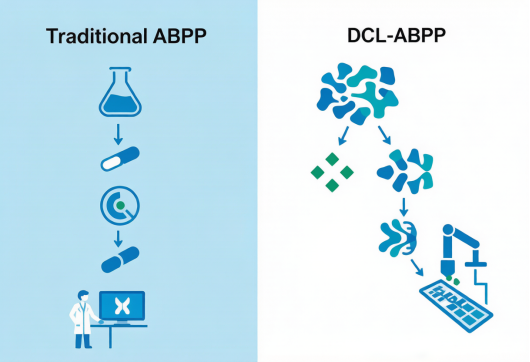
Figure 1 | Comparison of DCL-ABPP "library-versus-proteome" screening versus traditional ABPP single-compound screening paradigms. Left: the traditional method requires pre-synthesis and purification of a compound library, followed by stepwise competitive ABPP validation. Right: DCL-ABPP generates the molecular library in situ via dynamic combinatorial chemistry and competes simultaneously against the whole proteome, synthesizing only hit molecules afterward, achieving a paradigm shift of "screen first, synthesize later."
II. Step-by-Step Dissection: A Five-Step Technical Chain from "One-by-One Screening" to "Library-versus-Library"
Module 1: Dynamic Combinatorial Library Construction (DCL) — The Chemical Wisdom of Turning Complexity into Simplicity
Principle: Dynamic combinatorial chemistry (DCC) uses reversible chemical reactions (e.g., imine bonds, disulfide bonds, acylhydrazone bonds) to enable different molecular fragments to dynamically exchange and recombine within the system, spontaneously forming thermodynamically stable compound combinations. When a protein "template" is present in the system, molecules capable of binding the protein are preferentially enriched—this is the principle of template-driven ligand screening.
Experimental design:
- First-generation strategy: design electrophilic warhead scaffolds capable of reversible reaction with aldehyde fragments
- In situ construction of a dynamic molecular library with the fragment aldehyde library
- Whole-proteome-range screening via competition with serine hydrolase family probes (fluorophosphonate probes)
Why this was done: Traditional ABPP requires individual synthesis, purification, and stepwise competitive screening of each candidate compound. The key advantage of the DCL strategy is that the molecular library is "generated on-site" within the screening system, eliminating substantial upfront synthesis work. Meanwhile, the presence of the protein template naturally drives the chemical equilibrium toward high-affinity ligands.
Data and conclusions:
- Successfully discovered selective covalent inhibitors for serine hydrolases including PPME1, ABHD11, and PNPLA6
- The PNPLA6-specific inhibitor was reported for the first time—previously this protein lacked known selective chemical probes
- Using this inhibitor together with lipidomics analysis, systematically expanded the endogenous substrate profile of PNPLA6: it hydrolyzes not only LPC but also various lysophospholipids such as LPE and LPI
- Functional validation revealed PNPLA6's involvement in cancer cell proliferation regulation
Module 2: Cysteine-Targeting Expansion (2nd Gen DCL-ABPP) — From Family Targeting to Residue-Level Precision
Principle: Building on the successful validation of serine hydrolases, the group extended the platform to broader cysteine (Cys) residue targeting. The key innovation was designing bifunctional DCL members carrying both a reactive group and an alkyne tag. After such molecules covalently bind cysteine, they can be directly enriched via click chemistry (CuAAC) and the modified sites resolved by mass spectrometry.
Experimental design:
- DCL members: acrylamide warhead + alkyne tag
- Competitive ABPP design: use broad-spectrum cysteine probe (IA-rhodamine) as the readout
- TMT 10-plex labeled quantitative proteomics: only 8 mass spectrometry runs to simultaneously screen 80 candidate molecules
Why this was done: Traditional competitive ABPP struggles to resolve the independent activity of each ligand in complex mixtures at a large-scale site level. The second-generation strategy's innovation lies in directly "capturing" the modified cysteine sites via the alkyne tag, while using the mass shift after cysteine modification to directly resolve effective molecule structures in MS. Compared with the first generation, it eliminates the gel-analysis step for confirming effective ligands.
Data and conclusions:
- Obtained 2,627 "ligandable" cysteine sites and their apparent EC50 data
- Established a large-scale cysteine covalent ligand map
- Discovered selective covalent ligands for multiple proteins including NIT2, PRDX5, TXNDC17, RPS6KA1, and VCP
- Most target proteins previously lacked known inhibitors
Module 3: Functional Validation — The Causal Loop from "Binding" to "Function"
Principle: Discovering ligands is only the first step; validating whether ligands can regulate target protein function is the key. The group selected multiple representative ligands for in-depth functional validation, ensuring screening results hold "functional probe" value.
Experimental design:
- Target validation: competitive ABPP confirmed ligands' specific labeling of target proteins in protein lysates and live cells
- Enzyme activity assays: in vitro enzyme inhibition experiments with purified proteins
- Cellular function: monitored hydrogen peroxide metabolism changes in mitochondria after PRDX5 ligand treatment
Why this was done: Chemoproteomic screening is prone to false positives—a molecule may bind a protein without affecting its function. Only through orthogonal validation (enzyme activity + cellular function) can one advance from "binding event" to "functional event," completing the causal loop of target discovery.
Data and conclusions:
- PRDX5 ligand: significantly affected hydrogen peroxide metabolism in mitochondria, proving the platform-screened molecules have good functional-probe potential
- Each ligand specifically labeled the key functional sites of corresponding target proteins
- Multiple ligands demonstrated phenotypic regulatory capacity at the cellular level
Module 4: In-Depth Analysis of the VCP Target — From Target to Pathway to Mechanism
Principle: Among the many candidate targets, the group focused on VCP (Valosin-Containing Protein)—an AAA+ ATPase crucial in protein homeostasis regulation—as a model target for in-depth mechanistic study.
Experimental design:
- Target confirmation: validation of binding between G2-369 (a cysteine-targeting ligand obtained by screening) and VCP
- Enzyme activity inhibition: ATPase activity assay
- Pathway analysis: BONCAT nascent proteomics analysis
- Mechanism mining: ER stress-UPR pathway marker detection + GPCR signaling cross-analysis
Why this was done: VCP is a core component of the intracellular protein quality control system (ERAD pathway), but its regulatory mechanism is not fully understood. Using a highly selective chemical probe to perturb VCP function, combined with nascent proteomics to capture downstream responses, is a pathway-analysis strategy faster and closer to pharmacological intervention modes than traditional genetic means (siRNA/CRISPR).
Data and conclusions:
- G2-369 efficiently bound VCP and inhibited its ATPase activity, inducing marked cytotoxicity in cancer cells
- VCP C522 site inhibition → activation of endoplasmic reticulum stress–unfolded protein response (ER stress-UPR)
- New discovery: previously unreported crosstalk mechanism between GPCR signaling and ER stress
- GNG4 protein participates in regulating PERK and ATF4 signal activation
- Revealed that VCP-mediated cell death depends not only on the classic stress axis, but is also closely related to GPCR/ERK signaling branches
Module 5: Lead Compound Optimization — Rapid Iteration from "Hit" to "Drug Candidate"
Principle: After obtaining the lead molecule G2-369, the group demonstrated an impressive case: how to rapidly optimize a lead compound using the same platform. This is one of the biggest highlights distinguishing DCL-ABPP from traditional methods—the screening platform itself can be used for lead optimization.
Experimental design:
- Gel-based rapid competitive DCL-ABPP using G2-369 as the competitive probe
- Screening scope: 403 commercial aldehyde fragments × 2 warheads = 806 theoretical candidate molecules
- Time: only 2 days to complete all screening
- Obtained higher-activity VCP inhibitor compound 95
In vivo validation:
- Purified VCP protein: nanomolar enzyme-activity inhibition
- Lysates and live cells: superior inhibitory effect to G2-369
- HT29 and AMO1 tumor cells: significantly enhanced anti-proliferative activity, with IC50 as low as 78.9 nM in some cells
- HT29 colorectal cancer subcutaneous xenograft mouse model: 5 mg/kg intraperitoneal injection, 3 times weekly for 21 days → significantly inhibited tumor growth
Why this was done: Traditional lead optimization is a lengthy iterative process of "design → synthesis → test → redesign." The DCL-ABPP platform compresses this into a rapid cycle of "library generation → competitive screening → hit identification," greatly reducing synthesis burden and compressing lead optimization from "month-scale" to "day-scale."